

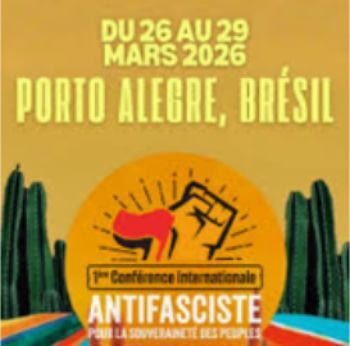
The First International Antifascist Conference of Porto Alegre: One Step Forward, Two Steps Back
Antifascism or Anti-Westernism?
The First International Antifascist Conference, held in Porto Alegre in late March 2026, drew delegations from over forty countries in what was, by any measure, a significant act of left internationalist assembly. Italian trade union and political activist Sergio Bellavita attended and offers an assessment that is candid about both the conference’s achievement and its failure. The gathering, he argues, succeeded in mobilising — but failed in analysis, substituting rhetoric for critical self-examination. Most damning: the conference’s final document erased Russia’s war in Ukraine and the repression of Iranian protesters from its account of the world’s barbarism, revealing a political thread that is less antifascist than anti-Western. [AN]
The first international antifascist conference ended with a long collective embrace on the stage of the Atos lecture hall at the University of Porto Alegre. [1] The four-day event was a gamble that paid off in terms of participation: delegations from over forty countries, a large contingent of young people from the Brazilian and Argentine left, activists from collectives, trade unionists, political and movement organisations, and veteran figures who had played significant roles in the cycle of movements that had once gathered momentum in Porto Alegre itself.
The attempt to reconnect the threads of an international political and movement space during so complex and dramatic a conjuncture as the present one substantially succeeded. Antifascism made it possible to address the key questions of the period: the return of large-scale warfare, the Palestinian genocide, the brutal resurgence of imperialism, and the global growth of the far right — together with its assault on civil rights, labour rights, gender equality, and democracy itself.
Yet a substantial portion of the contributions preferred heavy use of rhetoric and slogans to rigorous analysis and a self-critical reckoning with the role played by the left over recent decades.
Some contributions did attempt to open a discussion on the profound rupture between the popular movements that had enabled left electoral victories and the policies those governments subsequently pursued. The left’s break with its own base was identified as one of the factors behind the vertiginous rise of the far right — a process described as affecting the entirety of South America.
Setting those attempts aside, no speaker at the conference chose to interrogate the meaning of terms such as antifascism and anti-imperialism. What is fascism today? What characteristics define its boundaries? How is antifascism constructed? On all of these questions, speakers preferred to gloss over the difficulty, appealing to identitarian and self-referential registers, to symbolism — at the cost of erasing a reality far broader and more complex than the one desired.
It is precisely in this gap between reality and desire that the conference’s most glaring failure was located.
The final document details and denounces — in terms that are almost entirely shareable — the atrocities of the current period: the aggression against Iran, the attempted seizure of Maduro, [2] the crimes of Israel, the strangulation of Cuba. Yet it erases Putin’s imperialist war and the massacre of Iranian protesters by the ayatollahs’ regime.
This is not an innocent omission, still less an impossible neutral choice. To erase the war on Ukraine — now in its fifth year of barbarism, the longest war in the heart of Europe since the Second World War — appears as the obsolete and incomprehensible reflex of an affinity, devoid of any progressive content and on the contrary deeply troubling, with Putin’s despotic government. [3]
If antifascism is the antithesis of gender oppression and authoritarian regimes, why does the conference not express solidarity with the Iranian protesters who are demanding freedom and being killed in their thousands? This is entirely distinct from a firm condemnation of Trump’s imperialist aggression against Iran.
Unfortunately, far more than antifascism, the real political cement of the conference appears to have become anti-Westernism. [4] The conference’s four-day format also requires thorough revision. The more than a thousand participants at plenaries and debates were asked to function as an audience only. Pre-arranged contributions, pre-packaged debates — never an open space; even the final document was read out rapidly amid embraces on the stage.
This is not how to build the participation that is needed, if we genuinely want to be an alternative to the right. If the challenge of building the conference was met and marked a step forward, the final political positions — as in a board game — sent it back two squares.
Sergio Bellavita is an Italian political and social activist. He has been associated with FIOM-CGIL (Federazione Impiegati Operai Metallurgici — Confederazione Generale Italiana del Lavoro, the Italian metalworkers’ federation affiliated to the main trade union confederation) and later with USB (Unione Sindacale di Base, an independent base union).
P.S.
Source: Il Refrattario e controcorrente, 31 March 2026
https://andream94.wordpress.
Translated for ESSF by Adam Novak.